Bathrooms get designed around fixtures and lived in around objects. The plan shows a bath, a basin and a toilet; the reality involves shampoo, spare towels, cleaning products, medicines, a razor and whatever else the household has accumulated, and none of it appears on the drawing.
Fylde Bathrooms fits bathrooms across Lytham St Annes, and storage is the thing most often decided last and regretted first. It deserves to be settled with the layout, because most of the good answers involve walls that are about to be tiled.
Count what actually has to live in the room
Before choosing any unit, empty the current bathroom onto a bed and look at it. Almost everybody is surprised, and almost everybody discovers that a third of it does not need to be in the bathroom at all.
Sort it into three groups: things used daily and wanted within reach, things used occasionally, and bulk or spares that only need to be somewhere in the house. Only the first two need bathroom storage, and they need different kinds.
Daily items want to be at hand and visible, which usually means shallow and open. Occasional items want to be behind a door so the room reads as tidy. Bulk should leave the bathroom entirely if there is anywhere else for it, because bathroom storage is the most expensive storage in the house per litre.
That inventory is worth doing before the quote, because it changes the specification. It is exactly the kind of detail that keeps the recommendation practical alongside room photographs, dimensions and fixture choices.
- Empty the room out and sort into daily, occasional and bulk.
- Daily items: shallow, reachable, often open.
- Occasional items: behind a door for a tidy room.
- Bulk and spares: store them somewhere other than the bathroom.
The wall owes you more depth than you think
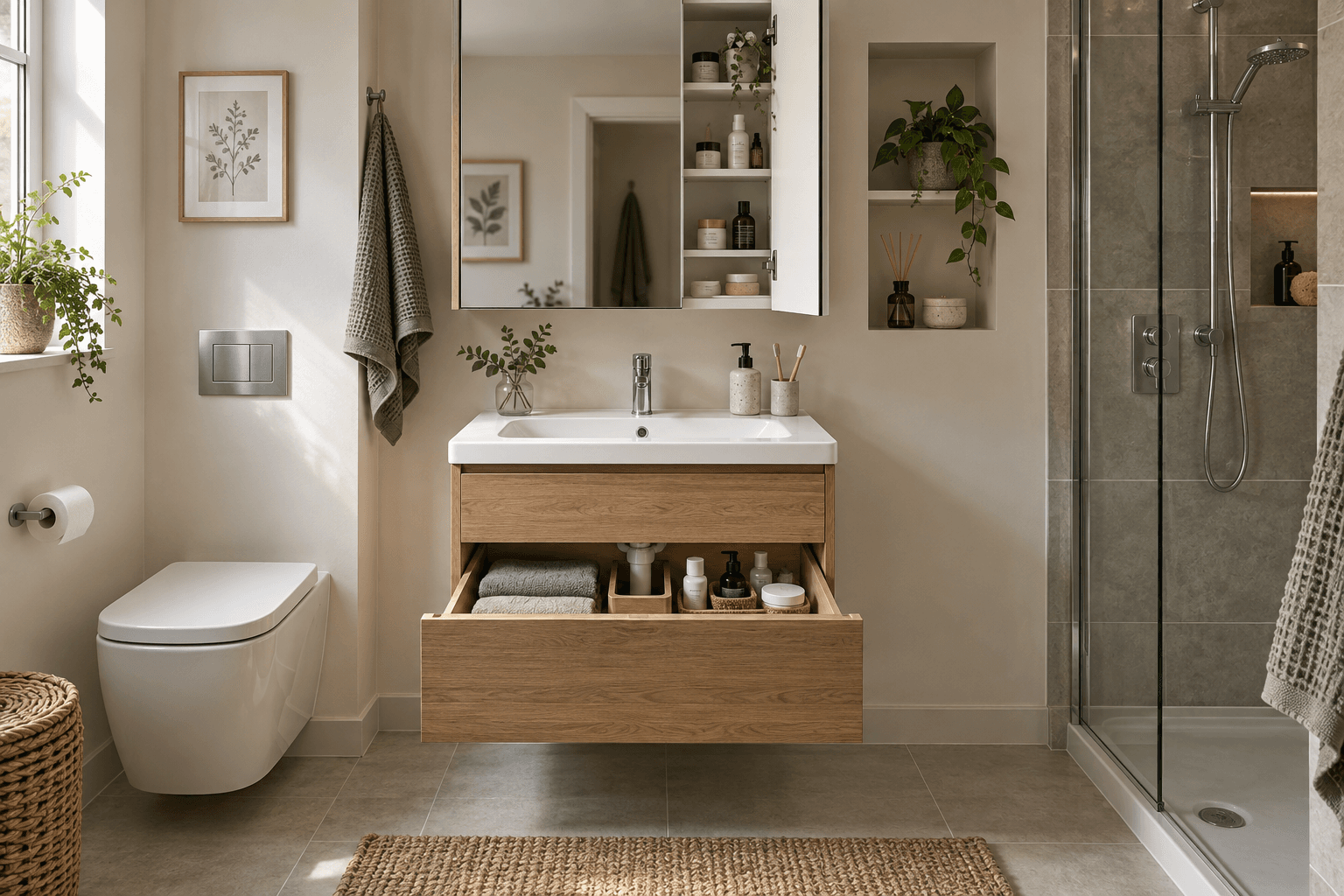
The most under-used storage in any bathroom is the depth of the wall itself. A mirrored cabinet turns a flat surface into a usable cupboard without taking a single centimetre of floor, and in a smaller room it is often the single best storage decision available.
Recessed niches in the shower or above the bath do the same job for bottles, and they remove the corner baskets and hanging racks that otherwise accumulate. They have to be formed during construction, though, because a niche is a hole in a wall that then gets waterproofed and tiled, and it cannot be added afterwards without undoing that work.
The wall above a toilet is usually dead space and takes a slim cabinet or shelf comfortably. The wall beside a basin often does too, though it is worth leaving elbow room rather than filling every surface.
All of these decisions have to be made before tiling, which is why storage belongs in the design conversation rather than in a shopping trip afterwards.
Vanity units, and what wall-hung actually buys
A vanity unit under the basin is the workhorse of bathroom storage, and the choice between floor-standing and wall-hung is worth understanding rather than choosing on appearance.
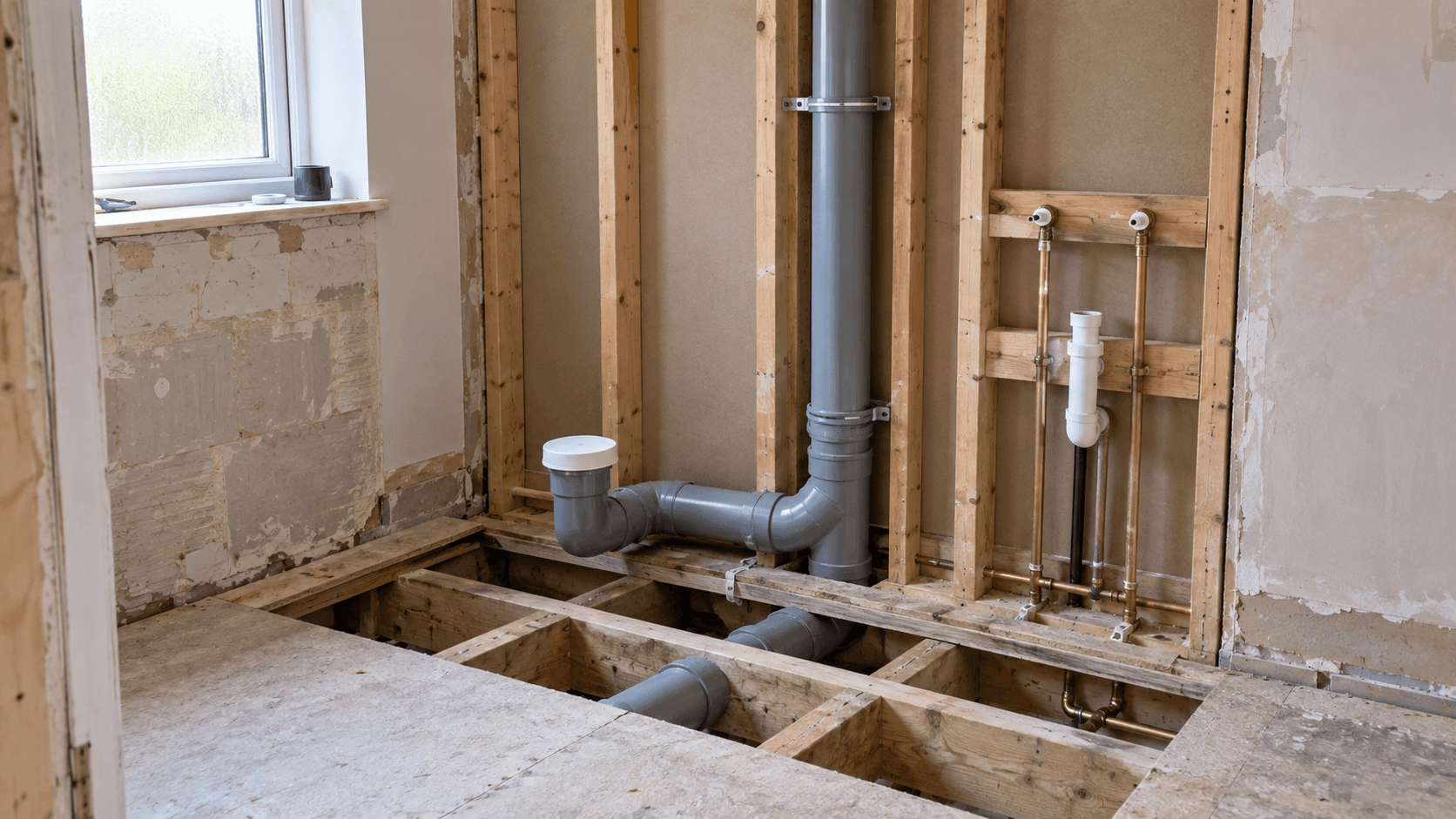
Wall-hung units keep the floor visible underneath, which makes a small room read as larger and makes cleaning much easier. They need a wall that can genuinely carry them, which means the fixings and any noggins have to be planned while the wall is open.
Drawers beat cupboards in almost every bathroom. A cupboard under a basin becomes a cave where things go to be forgotten behind the trap; drawers that pull out fully give you the whole depth and are shaped around the waste pipe rather than obstructed by it.
Where the room is tight, a smaller basin with a larger unit beneath it is frequently the better trade than the reverse. Basin size is rarely the constraint on how the room works; storage almost always is.
- Wall-hung units need planned fixings, decided before tiling.
- Drawers reach the back; cupboards under basins rarely do.
- A smaller basin with a bigger unit usually beats the opposite.
- Leave elbow room rather than filling every surface.
Towels, ventilation and the things people forget
Towels are bulkier than anything else in the room and are usually the last thing considered. A heated towel rail holds one or two in use but is not storage, so somewhere for clean spares still has to exist or they end up on the floor.
Damp is the constraint people overlook. A closed cupboard full of towels in a poorly ventilated bathroom is a place for mustiness rather than storage, which is one more reason extraction and storage should be designed together rather than separately.
Two small practical items are worth naming. Anything that must be kept out of reach of children needs a specific home rather than a high shelf that turns out to be reachable. And a bin needs a planned position, because the space left over after everything else is fitted is almost never the right one.
Fylde Bathrooms works through storage, layout, ventilation and fixture choices as one conversation, which is the only stage at which most of these can still be changed for free.
Related pages
Questions customers ask
What is the best storage for a small bathroom?
The wall. A mirrored cabinet and recessed niches give you storage without using floor, and a wall-hung vanity keeps the floor visible so the room reads larger. Niches in particular must be formed during construction rather than added later.
Are drawers better than cupboards under a basin?
Usually, yes. A cupboard under a basin becomes hard to use because the trap is in the way, whereas drawers pull out fully and are built around the waste pipe. It is one of the more reliable improvements to how a bathroom works day to day.
When do I need to decide on storage?
Before tiling, and ideally with the layout. Niches, cabinet recesses and the fixings for wall-hung units all have to be built into the wall, so they are free to plan and disruptive to add once the room is finished.
Empty the room out, decide what genuinely has to live there, then take the storage out of the walls before they are tiled. Almost every good bathroom storage decision is made before the first tile goes on.
Fylde Bathrooms plans bathrooms in Lytham St Annes with storage in the layout conversation. The contact page is the place to start.